
Description of sleep parameters
General#
This article describes the different parameters in the “Activity & Sleep” algorithm.
SENS motion can, among others, be used to provide an objective assessment of sleep quality. This is done with the “Activity & Sleep” algorithm, which is based on measuring movement during sleep, sleep quality and sleeping position.
The algorithm is built to find the time where a participant goes to bed between 7 PM and 1 AM, and the time where a participant gets up between 5 AM and 12 PM. Note that the algorithm detects going-to-bed time based on movement patterns, not necessarily the moment the participant falls asleep. The algorithm only determines sleep at night, and does not regard naps during the day as sleep. Therefore the algorithm will not work for participants with irregular sleeping schedules.
Below you see an example of the “Activity & Sleep” algorithm applied on a real measurement.
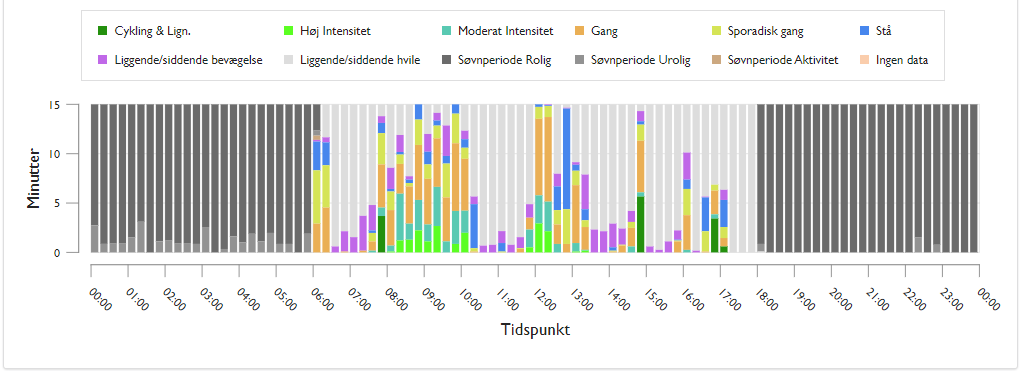
For a description of the general activity categories, please refer to this article: Activity categories in Webapp and CSV export
Description of Sleep Parameters#
The “Activity & Sleep” algorithm assesses movements during sleep, duration of sleep and sleeping position. The following table describes the different parameters.
The categorization of movement relies on “intensity count”. Read more about intensity count in this article: Activity categories in Webapp and CSV export
Bold: categories as seen on the web-app
Italics: categories as seen on an exported CSV-file
| Parameter | Description |
|---|---|
| Duration of sleep | Estimates when the participant sleeps (time between going to bed and getting up). The participant is estimated to have gone to bed the last time the participant is upright for more than 45 seconds within a 2-minute window, between 7 PM and 1 AM. The participant is estimated to have woken up the first time the participant is up and walking for more than 30 seconds between 5 AM and 12 PM. |
| Sleep No Movement sleep_no_movement | The participant is without movement. This is typically lying horizontally (+- 45 degrees), but standing still during the sleep period is also categorized as Sleep No Movement. Movements with intensity count under 2 are also categorized as Sleep No Movement. |
| Sleep Movement sleep_movement | The participant lies horizontally (+- 45 degrees) with minimal to moderate movements. Movements with an intensity count over 2 is categorized as Sleep Movement. The movement is quantified with +30 seconds before and after the movement. For instance, a movement lasting 10 seconds will be assigned this category with +30 seconds before and after the movement. This means a total of 1 minute and 10 seconds categorized as Sleep Movement. Note that movements in this category usually happen during light sleep. |
| Sleep Active sleep_active | The participant is upright (vertical +- 45 degrees) and moving, i.e. walking sporadically, walking, or moving at moderate or high intensity. Standing still is not categorized as Sleep Active. If the participant stands upright without moving during the sleep period, this is categorized as Sleep No Movement, or as Sleep Movement if it happens within 30 seconds of a movement. |
The information above is based on these references:
- J. B. Webster et al. An Activity Based Sleep Monitor System for Ambulatory Use.
- J. D. van der Berg et al. Identifying waking time in 24 h accelerometry data in adults using an automated Algorithm.
- Input from Professor Poul Jennum from Glostrup Hospital